
From the Litle Pups journal · Est. 2011
From Brief to Locked Formula: The Exclusivity Steps That Hold Up
Exclusivity is rarely lost in one dramatic moment; it is lost in the gaps between documents. Most brands ask for exclusivity in the purchase order, after the formula has already been built, and discover that the development agreement said nothing about ownership at all. The workable order is different: settle what needs protecting, write it into the development agreement, fix who owns the intermediate work, take delivery of the formula as a record, and only then agree on the window during which the supplier cannot repeat it for someone else.
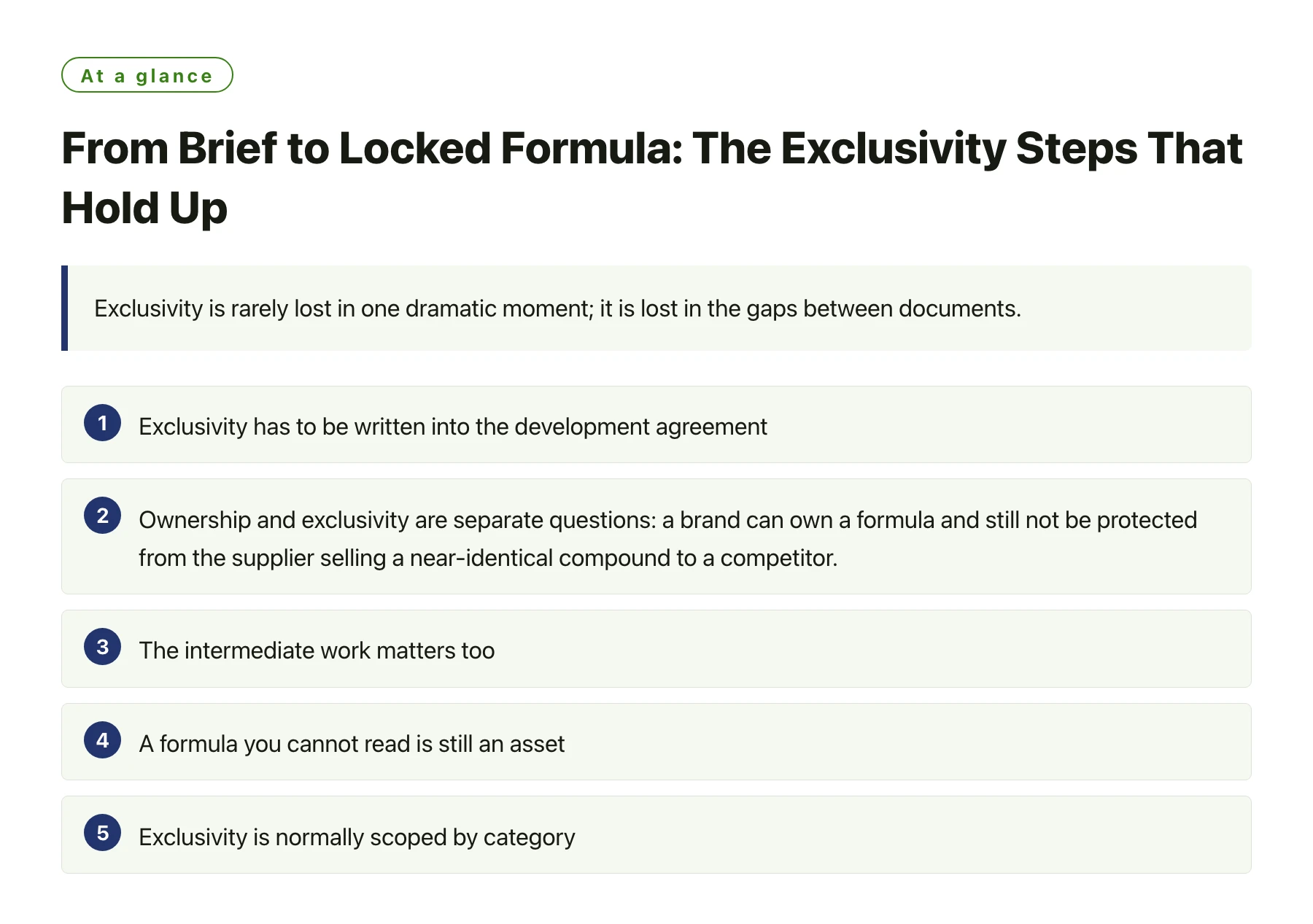
Key takeaways
- Exclusivity has to be written into the development agreement, because a purchase order normally describes goods rather than rights.
- Ownership and exclusivity are separate questions: a brand can own a formula and still not be protected from the supplier selling a near-identical compound to a competitor.
- The intermediate work matters too, including the brief, the trial versions and the sensory notes recorded along the way, because those are what make a formula reproducible.
- A formula you cannot read is still an asset, but only if the contract gives you a copy, a specification record or an agreed handover route when the relationship ends.
- Exclusivity is normally scoped by category, market and time, and a supplier that asks for those limits is negotiating properly rather than refusing.
A scent that any competitor can order from the same factory is not a brand asset, it is a rented smell. That is why exclusivity comes up in almost every first conversation with a fragrance supplier, and why so many of those conversations end with a vague verbal assurance.
A verbal assurance is worth what it costs. The protection lives in the paperwork, and the paperwork is easier to get before the formula exists than after it has been paid for. This is the order that keeps the negotiation honest for an e-commerce brand that intends to build a range rather than launch one product.
The step order that actually protects a formula
- Decide what you are protectingName the thing: the exact compound, the name, the bottle design, the market, the selling window. Exclusivity requests that stay abstract are the easiest ones to answer with a promise.
- Put it in the development agreement, not the purchase orderThe agreement is where rights are described. A purchase order that mentions exclusivity is a note, not a term.
- Separate ownership from exclusionOwnership answers who holds the formula; exclusion answers who else may use it. Ask for both, and expect them to be priced and scoped differently.
- Fix the status of the intermediate workThe brief, the rejected trials and the sensory records are part of how the final scent was reached, so the contract should say who holds them.
- Take delivery in a form you can keepAgree in advance whether you receive a full formula, a specification sheet, a reference sample or all three, and whether technical documentation comes with it.
- Write the exclusion window and its exceptionsCategory, territory and duration belong in the agreement, along with any carve-outs for the supplier's existing library or other clients.
- Rehearse the exitAsk what happens if the relationship ends: who keeps the formula, what the other party may still produce, and how long any transition period lasts.
Where exclusivity arguments usually start
The most common dispute is not about theft, it is about scope. A brand asks for exclusivity and assumes it means the supplier will never sell a similar scent to anyone, in any market, forever. The supplier reads the same word as covering the identical compound for a defined product category in a defined territory for a defined period. Both parties leave the meeting satisfied and discover the gap a year later.
The second dispute is about the library. A supplier that develops a scent for you may also hold a stock direction that is 80 percent of the way there. If the agreement does not address how close a later scent may come, the brand is left arguing about similarity, which is exactly the argument nobody wins.
The third is about records. When a formula lives only in the supplier's system, the brand's protection depends on the supplier continuing to exist and continuing to be cooperative. That is a business risk rather than a legal one, and it is addressed by delivery of documentation, not by stronger wording [1]. It is also the reason some brands look for a partner whose development and production sit in one organisation: a single record-holder is easier to hold to a term than a chain of subcontractors. A fragrance house such as Xuelei Fragrance keeps both functions in the same operation, which is the arrangement that makes the delivery step on the list above achievable rather than theoretical.
A short test worth applying to any exclusivity clause: if the supplier's perfumer left tomorrow and the factory closed next month, could another lab rebuild your scent from what you hold? If the answer is no, the exclusivity is thinner than the paper it is written on.
What a supplier can legitimately refuse
Not every exclusivity request is reasonable, and a supplier that agrees to all of them without discussion is worth a second look. Carve-outs for scents already in development for another client are normal, because retroactive exclusion would require the supplier to breach an existing deal. Limits by product category are also normal, since a compound designed for an eau de parfum behaves differently in a candle and the supplier may have built it for both.
Time limits are the third normal carve-out. Perpetual, worldwide, all-category exclusivity on a compound that the supplier partly owns is a large concession, and asking for it on a first run of a few thousand units is usually a signal that the brand has not priced what it is asking for.
The useful move for an e-commerce brand is to negotiate in stages. Secure ownership and documentation of the formula first, since those cost the supplier little and protect the brand's ability to continue. Negotiate the exclusion window when volumes justify it, and be explicit about which competitor categories matter most to the range.
Industry guidance on fragrance materials and allergen disclosure is widely published, and it is a reasonable thing to expect a development partner to work with rather than around [2]. A supplier that treats documentation as part of the service tends to treat exclusivity the same way.
Finally, an exclusivity term is only as useful as the product it covers. A scent that is developed in close collaboration with a partner who builds bespoke fragrances for individual brands is easier to protect than one adapted from a shared catalogue bespoke fragrance development and production, because the starting point is already specific to you. Where a range depends on speed and price rather than on a signature, private label terms are the more honest framework a private label partner for perfume lines, and the exclusivity conversation should be replaced by a candid discussion about how many other clients may receive the same compound.
Sources
- WIPO — World Intellectual Property Organization —— The UN agency for intellectual property; resources on industrial design and patent protection relevant to product and packaging design.
- Cosmetics Europe —— The European trade association for the cosmetics and personal care industry, publishing guidance, positions and market information.
Frequently asked questions
Does paying a development fee mean the brand owns the formula?
Not automatically. Payment buys the work; ownership is a separate term that has to be written into the agreement. Many suppliers retain the formula while granting the brand an exclusive right to use it, which is a different arrangement.
How long should an exclusivity period be?
It should match the commercial life of the product. Exclusive rights tied to an active supply relationship are easier to agree than open-ended rights, and they can be renewed when volume justifies it.
Can a supplier refuse to hand over the formula?
Yes, and many do, because the formula is their intellectual property and often their competitive advantage. In that case the brand should ask for a specification record, a retained reference sample and a documented route to continued supply.
What happens to exclusivity if the brand switches supplier?
It depends entirely on what the agreement says about termination. Without a clause covering it, exclusivity usually ends with the commercial relationship, which is why the exit should be drafted while both parties are still friendly.
Is exclusivity worth paying for on a first order?
It depends on whether the scent is the brand. A range built on price and speed rarely needs it; a house built on a signature scent usually does, and buying it later is more expensive than buying it at the start.
Thinking about a tiny companion?
Meet the puppies waiting for their forever home.
Browse current available toy puppies, or start a reservation application and our team will guide you, one warm step at a time.